A great marketing campaign does more than sell a product. It shapes how people think, feel and act.
CONTENTS
- How the Campaign Shapes Perception, Eight Key Elements
- Open Pastures and Free-Roaming Cattle
- The Use of Modern Technology
- Preserving Grasslands and Wildlife With Integrity
- "Care" and a "Balanced Diet"
- Humane Handling and Safety Testing
- From Pasture to Plate
- The Family Dinner Scene
- The Music and Tone
- How Cattle Actually Get to Market
- The Reality of Grass-Fed Beef
- The Bigger Picture
In the early 1980s, the U.S. beef industry had a problem. Demand was slipping because consumers were starting to question the healthiness of eating red meat, especially around fat and cholesterol. At the same time, chicken and pork were gaining ground, which were often marketed as healthier and more affordable alternatives. For cattle producers already dealing with economic pressure, this shift was more than a trend. It was a threat to the entire industry.
Congress recognized a need to boost beef demand. In 1985, lawmakers passed the Beef Promotion and Research Act, declaring it in the public interest to strengthen the beef industry and expand demand.
The Act created what is now known as the Beef Checkoff Program, a mandatory $1 per head assessment on cattle sales. That funding would be used for advertising, research and consumer education, all with one goal, get Americans to eat more beef.
To carry this out, the government established a producer-led board working alongside the USDA, with execution largely handled through organizations like the National Cattlemen's Beef Association. The structure ensured something the industry had never really had before, a steady, guaranteed stream of funding for a coordinated national marketing effort.
It was, in essence, a government-backed marketing machine.
And it worked.
In 1992, the National Cattlemen's Beef Association launched the "Beef, It's What's for Dinner" advertising campaign. The tagline is one of the most recognized in American advertising and remains in use today. Few marketing campaigns have achieved that level of longevity or brand recognition.
One could argue that the campaign has been extraordinarily successful.
But is what they are selling really true?
How the Campaign Shapes Perception, Eight Key Elements
1. Open Pastures and Free-Roaming Cattle
The Message:
Cattle live a good life, roaming freely across open land.
The Truth:
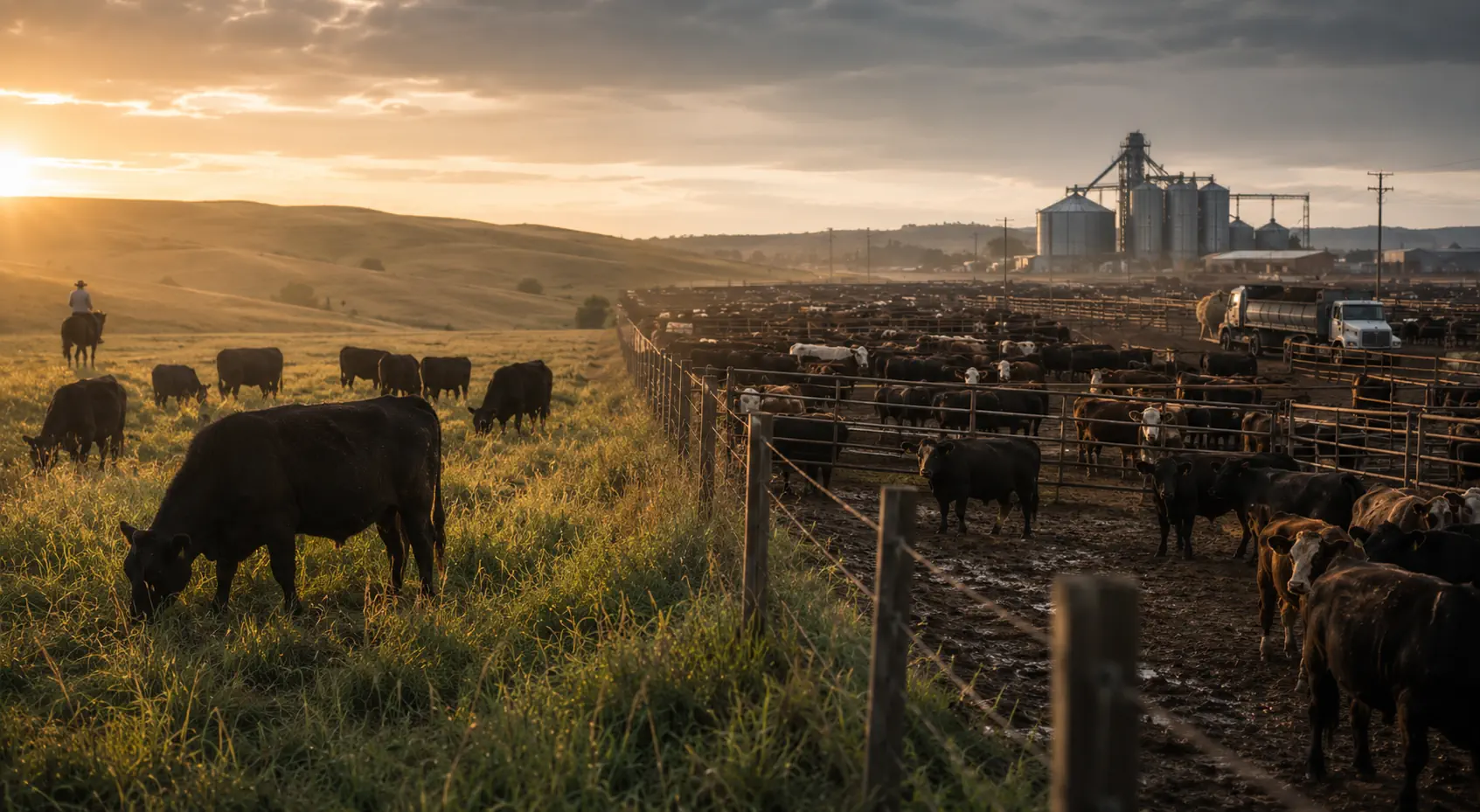
The overwhelming majority of beef cattle spend most of their life confined in large scale feeding operations, where they live mostly indoors, in a factory like setting. These environments look nothing like the open pastures shown in the advertisement. The imagery reflects a miniscule slice of reality, not the dominant production system.
2. The Use of Modern Technology
The Message:
Farmers use advanced tools, such as drones, to monitor and care for their animals, suggesting precision and responsibility.
The Truth:
Technology may be used, but its presence alone does not indicate improved animal welfare, better nutrition or higher quality beef. It signals efficiency, not necessarily better outcomes. The assumption that technology equals better care is left for the viewer to make-and is false.
3. Preserving Grasslands and Wildlife With Integrity
The Message:
The farmer is preserving native grasslands and wildlife, operating with integrity and environmental responsibility.
The Truth:
Large-scale cattle production, also known as factory farming or Concentrated Animal Feeding Operations, when tied to grain-fed systems contribute to land use changes, monocropping (the practice of growing the same crop in a field over and over again until the soil is depleted of all nutrients) and loss of biodiversity. The broader system relies heavily on corn and soy production, which carries a significant ecological footprint.
If we define integrity as acting with honesty and strong moral principles even when no one is watching, then the lack of transparency in large-scale operations raises serious questions. If there is nothing wrong with how these CAFO’s are operated, why do laws like the Animal Enterprise Terrorism Act and ag-gag laws exist? Both are laws that restrict journalists and animal advocates from documenting how animals are really treated within these facilities.
4. "Care" and a "Balanced Diet"
The Message:
Cattle are well cared for and given a balanced diet with the right mix of nutrients.
The Truth:
Cattle are indeed "cared for" in the sense that they are valuable assets. But the implication is deeper, that they are cared for in a way that prioritizes their well-being.
In reality, most cattle are transitioned to an unnatural diet heavy in soy and corn which their bodies are not designed to digest.
In his 2006 book, The Omnivore's Dilemma, journalist Michael Pollan observes, “The cow is a creature of the grass.” Yet most cattle ultimately spend their final months consuming a corn-based diet designed to maximize weight gain and profitability. This raises an obvious question: if an animal is fed a diet contrary to its biological design, can that truly be described as caring for the animal’s welfare?
5. Humane Handling and Safety Testing
The Message:
Cattle are treated humanely, and strict safety protocols ensure the food supply is safe.
The Truth:
There are laws on the books regarding humane treatment, but enforcement has been notoriously inconsistent. Reports and firsthand accounts including undercover footage have documented conditions that conflict with the image presented.
In his book, Pollan describes feedlot cattle as standing ankle-deep in manure. While 20 years have passed since he wrote his book, this is still a concern. Feedlots concentrate thousands of cattle in confined outdoor pens where manure accumulates continuously. Depending on weather and management practices, cattle may spend significant periods standing in mud and manure.
As for safety testing, USDA FSIS (Food Safety Inspection Service) inspectors are routinely on site at slaughterhouses to perform inspections of the cows before slaughter, their corpses after slaughter, and to ensure the animals are safe to enter the human food supply. The often-inadequate training of the inspectors, a resistance to disrupting the workflow, and their intense workload make the reliability of the safety testing questionable.
6. From Pasture to Plate
The Message:
Beef comes directly from a farmer's pasture to your plate in a simple, transparent process.
The Truth:
The actual journey is far more complex. Cattle move through multiple stages, often changing hands several times before reaching slaughter. Once they reach the feedlot, they never see a pasture again. With a majority of the U.S. beef market dominated by a small number of giant international megacorporations (often referred to as “Big Ag”) that prioritize efficiency and scale over farmers, animal well-being, and producing a quality product, small family farms continue to disappear and are responsible for a tiny fraction of national beef production. The “pasture to plate” idea is very misleading.
7. The Family Dinner Scene
The Message:
Eating beef is part of family life, connection and shared tradition.
The Truth:
Food carries strong emotional and cultural meaning. This scene reinforces the idea that beef is central to family experiences.
While that may be true for many, it also shifts the focus away from how the food is produced, and that one can enjoy a family meal or celebrate culture regardless of what kind of food is on the table. The emotional connection makes the product harder to question.
8. The Music and Tone
The Message:
The solo banjo soundtrack attempts to invoke the idea of a “simple country farm” and nostalgia to a simpler time in line with multiple scenes of free roaming cattle on an open pasture.
The Truth:
The music reinforces a version of agriculture that no longer represents the dominant system. Large-scale production has replaced much of the small, traditional model the campaign evokes.
The tone is designed to create comfort and familiarity, even if the underlying system has fundamentally changed.
How Cattle Actually Get to Market
To understand what is missing from the campaign, it helps to understand how cattle move through the production system.
1. Cow-Calf Operations
This is where cattle are born and spend the early part of their lives. These are often the family ranches referenced in advertising. The calves are born on the ranch and stay with their mothers, nursing and grazing.
This part of the story is real and aligns closely with the imagery used in the campaign.
2. Backgrounding Operations
At 6-8 months, calves are weaned. They typically weigh between 400 and 700 pounds and are sold or transferred to backgrounding operations where they continue to grow. They typically stay in backgrounding operations for 3 to 8 months and weigh between 700 and 900 pounds.
Conditions in backgrounding operations vary widely. A minority are pasture-based, while others are more confined. (And the claims on the packaging are poorly regulated and often confusing.) In this phase they will be fed grass, if there is a pasture, but more likely they will be fed hay, silage, some grain, and protein supplements. This stage helps calves get used to their new foods and prepares cattle for the final phase of production.
3. Feedlots (CAFOs)
In the final stage, cattle are moved into feedlots for approximately four to six months.
Here they are fed a high-energy diet, typically corn-based, to maximize weight gain and consistency. This is where the system becomes highly standardized and industrialized.
This stage also represents the sharpest contrast with the imagery presented in most beef advertising.
The Reality of Grass-Fed Beef
Grass-fed, grass-finished beef sounds very much like the system most consumers imagine when they see these advertisements.
In reality, it is far less common than many people realize.
Most commercially available beef is grain-finished and moves through the industrial system. Beef that is genuinely grass-fed and grass-finished is often imported or purchased directly from smaller local producers.
That model exists, but it is not the dominant one. It is more difficult to scale, takes longer to produce and since federal subsidies largely are directed to Big Ag, it often costs much more at the grocery store.
Yet it more closely resembles the image that consumers are shown in many beef advertisements.
The Bigger Picture
When you step back and examine the campaign as a whole, a pattern emerges.
The campaign is not built on outright falsehoods. Rather, it is built on selective truth. It highlights the parts of the system that feel familiar, comforting and reassuring while leaving out the parts that are more complicated, industrialized or uncomfortable.
That is precisely what successful marketing campaigns do. They do not necessarily change reality. They shape perception. To recap, the campaign neither addresses the realities nor the consequences of the CAFO system:
- The animals are not fed a natural diet.
- The animals are routinely fed antibiotics that enter our food supply.
- In feedlots, the animals often live in intense confinement, barely able to turn around or lie down.
- “Industry practice” for raising the cows, like branding, castrating, and horn cutting, are not mentioned. How could any of this be considered “humane handling”?
- Nowhere in the ad is there a factory farm building where approximately 99% of beef cattle spend a good portion of their lives. Standing in cramped quarters, in their own manure, barely able to move or express their natural behaviors, fed an unnatural diet (thanks to that diet being subsidized by the taxpayer).
- The consequences to the environment that occur as a result of the manner in which these animals are raised: air pollution, water pollution, greenhouse gas release contributing to global warming, cancer risks from nearby pesticide use, and the noise and smell nuisance that nearby communities must endure.
- The final product is unhealthy. Consumption of processed red meat is linked to an increased risk of cancer, and consumption of unprocessed red meat is likely linked to cancer and many other diseases such as diabetes. (This campaign suggests eating beef for breakfast, lunch, dinner and even for snacks!)
The Beef, It's What's for Dinner campaign has undoubtedly succeeded in promoting beef consumption and strengthening the beef industry's position in the marketplace. That was the purpose of the Beef Promotion and Research Act of 1985, and by many measures it has accomplished exactly what Congress intended.
Forty years later, however, important questions remain.
*Is it appropriate for the federal government to continue funding and promoting increased beef consumption despite growing concerns about public health, environmental impacts and animal welfare?
*Should taxpayers and consumers have a clearer understanding of how the system actually operates?
*And does a campaign built around imagery of open pastures accurately reflect the dominant reality of modern beef production?
Those are questions each consumer must answer for themselves.
What is clear is that one of the most successful marketing campaigns in American history has shaped how generations of Americans think about beef. Whether that perception reflects the complete truth is a different question altogether.
In our next blog, we’ll continue this discussion focusing on the legal framework behind the campaign.