The Beef Checkoff Program: The Legal Framework Behind the "Beef, It's What's for Dinner" Campaign
How a federally authorized marketing program became one of America's most recognizable advertising campaigns, and why its legal foundation continues to spark debate.
CONTENTS
- The Supreme Court Decides: Government Speech
- What Exactly Is the Government Promoting?
- Animal Welfare: The Missing Conversation
- The Health Question
- Three Areas Where Critics Say the System Moved in the Wrong Direction
- A Contradiction Worth Discussing
- Forty Years Later: Does the Beef Checkoff Program Still Serve the Public Interest?
Summary
In the first part of this series, we examined how the "Beef, It's What's for Dinner" campaign uses imagery, language, and emotion to shape public perception of the beef industry. We explored the contrast between the idyllic world portrayed in the advertisements and the realities of modern cattle production.
But there is another side to this story that receives far less attention.
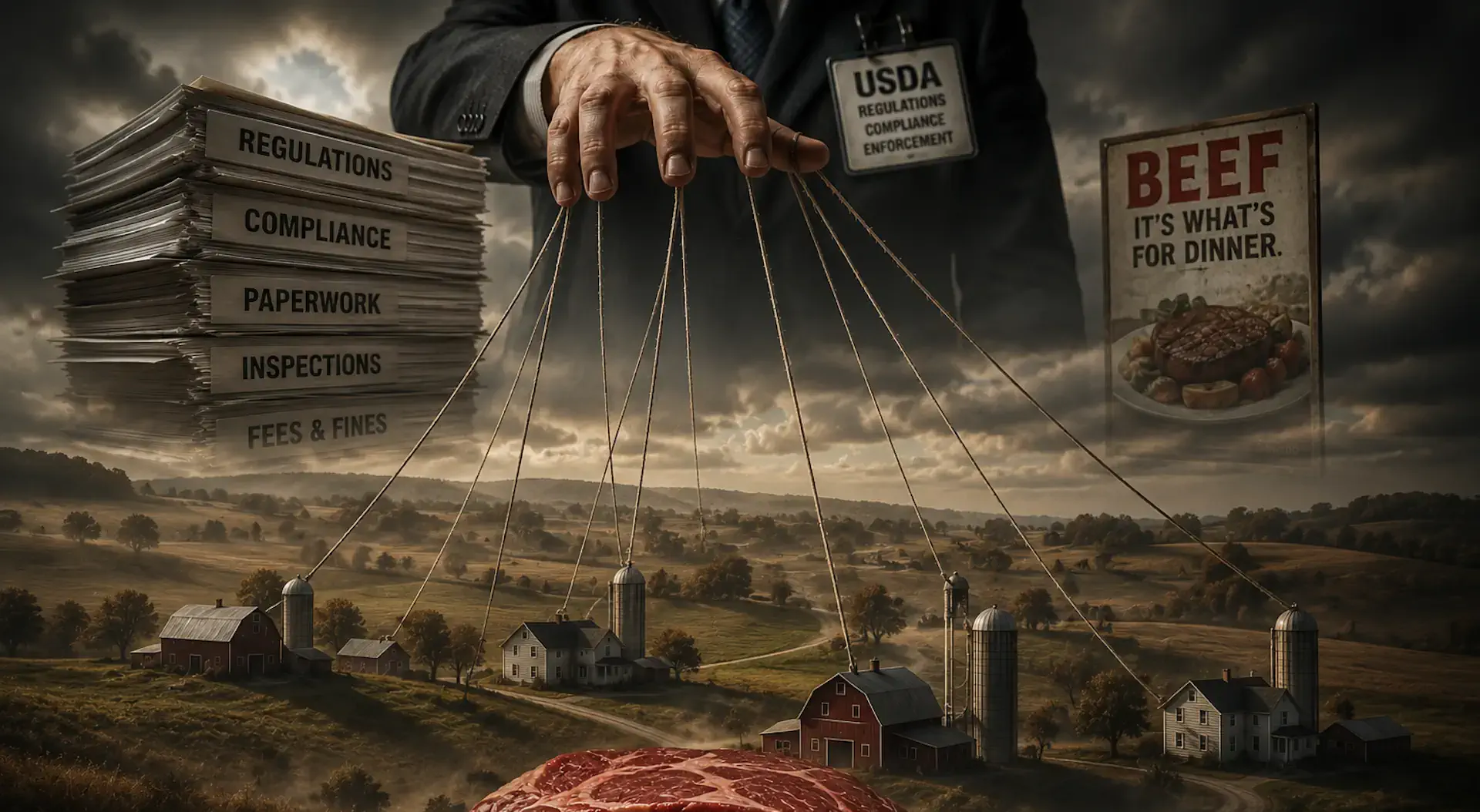
Most Americans assume "Beef, It's What's for Dinner" is simply an advertising campaign created by the beef industry. In reality, the campaign exists because Congress passed the Beef Promotion and Research Act of 1985 which declared that strengthening the beef industry's position in the marketplace was in the public interest. To achieve that goal, Congress established a mandatory funding mechanism known as the Beef Checkoff Program and placed the program under USDA oversight.
In other words, this is not merely private advertising. It is a federally authorized promotional program whose purpose is to increase demand for beef.
That distinction became important enough to reach the United States Supreme Court.
The Supreme Court Decides: Government Speech
In 2005, a group of cattle producers challenged the Beef Checkoff Program in a case known as Johanns v. Livestock Marketing Association.
The producers argued that they were being forced to fund speech with which they disagreed. Their position was straightforward. If the government can require ranchers to pay for advertisements promoting beef, does that violate the First Amendment?
The Supreme Court ultimately ruled that it did not.
The Court held that the promotional messages generated through the Beef Checkoff Program constitute government speech. Because the campaign is considered government speech, the government may promote those messages even when some producers disagree.
The ruling effectively cemented the legal foundation of the campaign and protected its future.
The significance of this decision extends far beyond beef. It established the legal basis for similar commodity promotion campaigns, including programs supporting milk, pork, eggs, and other agricultural products.
The legal question may have been settled, but the ethical questions remain.
The Health Question
The campaign presents beef as a wholesome, nutritious part of a healthy diet.
To be fair, beef does provide valuable nutrients, including protein, iron, zinc, and vitamin B12.
The issue is not whether beef contains nutrients.
The question is whether promoting increased beef consumption remains consistent with modern public health knowledge.
For decades, researchers have examined associations between red meat consumption and chronic disease. While the science continues to evolve, concerns regarding saturated fat, cardiovascular disease, certain cancers, and metabolic disorders remain part of the public health conversation. The "weight of the evidence" suggests that higher consumption of red meat leads to a greater risk of disease and illness, including cancer.
Yet the objective of the Checkoff Program is not to encourage moderation.
The objective is to increase demand. And sales.
That distinction matters.
A public health campaign asks what level of consumption is best for human health.
A marketing campaign asks how consumption can be increased.
Those goals are not necessarily the same.
What Exactly Is the Government Promoting?
The campaign suggests that beef is produced by hardworking family ranchers who raise cattle responsibly, care for the land, and provide a wholesome food source for American families.
There is truth in that image.
Most cattle do begin life on family-operated ranches.
Yet the modern beef supply chain extends far beyond the ranch.
Today, a relatively small number of corporations dominate meat processing in the United States. Companies such as JBS, Tyson Foods, Cargill, and National Beef process the majority of cattle brought to market.
JBS alone is the largest beef processor in the world processing 85% of the beef in the United States.
While these corporations may not own the cattle themselves, they exert tremendous influence over how the system operates. The economic incentives throughout the supply chain favor efficiency, scale, uniformity, and predictable production.
The result is a system that often looks very different from the one consumers imagine when they see advertisements featuring open pastures and free-roaming cattle.
Animal Welfare: The Missing Conversation
Perhaps the most controversial aspect of modern beef production involves animal welfare.
The advertisements repeatedly use terms such as "care," "humane handling," and "integrity." These words create the impression that animal welfare is a central priority throughout the production process.
But what do those terms actually mean?
Most consumers never see a feedlot.
They never see thousands of cattle confined to outdoor pens. They never see animals standing on surfaces covered in manure. They never see the transportation process, branding, dehorning, castration, or the realities of industrial slaughter.
Michael Pollan explored many of these issues in The Omnivore's Dilemma. He noted that cattle evolved as grazing animals and described feedlots as systems designed primarily for efficiency and rapid weight gain.
As Pollan famously observed, "The cow is a creature of the grass."
Yet most cattle spend their final months consuming grain-based diets specifically designed to maximize production.
Whether that represents good animal care or simply efficient animal production depends largely on one's perspective.
Three Areas Where Critics Say the System Moved in the Wrong Direction
Supporters of the Beef Checkoff Program often point out that the campaign itself does not dictate how cattle are raised, how slaughterhouses operate, or how regulators enforce existing laws. That is true.
However, critics argue that while the government continued promoting beef consumption, it failed to strengthen transparency, animal welfare protections, and public health safeguards at the same pace that industrial agriculture expanded.
Three areas are frequently cited.
Transparency
For consumers to make informed decisions, they must first understand how their food is produced.
Over the past two decades, several states have enacted laws commonly referred to as "Ag-Gag" laws. While the details vary from state to state, these laws generally restrict undercover investigations and secret recordings inside agricultural facilities.
Supporters argue these laws protect farms from harassment, trespassing, and deceptive practices.
Critics, and often the courts, see them differently.
The argument that the public has a legitimate interest in understanding how animals are treated and how food is produced or at least having access to that information. When obtaining that information becomes more difficult, consumers are left relying largely on industry messaging and government assurances.
The Animal Enterprise Terrorism Act, passed in 2006, has generated similar concerns. Although intended to protect agricultural businesses from criminal activity and economic sabotage, critics argue that it may discourage whistleblowers and investigative efforts that expose questionable practices. The result of the law is often a "chilling effect" on activities that otherwise might be protected under the First Amendment.
Many believe the net result is less transparency at a time when consumers increasingly want more.
Humane Treatment
The beef industry frequently emphasizes animal welfare and humane handling. Most consumers would likely assume that animal welfare protections have strengthened as operations have become larger and more sophisticated.
The opposite is actually closer to the truth.
Federal laws such as the Humane Methods of Slaughter Act and the Twenty-Eight Hour Law have existed for decades. However, review of public records reveal that enforcement has been poor and almost nonexistent.
As slaughter facilities have become larger and more concentrated, concerns have emerged about processing speeds, oversight, and the ability to consistently maintain humane handling standards.
At the same time, routine industry practices such as branding, dehorning, castration, transportation, and confinement remain largely invisible to the public.
This creates a disconnect between the image presented in advertising and the realities of industrial livestock production.
Many argue that a system such as Industrial Animal Agriculture, optimized for efficiency, viewing animals as commodities and not sentient beings capable of feeling pain and suffering, can truly prioritize animal welfare to the degree consumers are led to believe.
Public Health
The health conversation surrounding beef has also evolved considerably since 1985.
Over the past several decades, researchers have continued to examine associations between red meat consumption and chronic diseases including heart disease, certain cancers, and diabetes. While nutrition science is often complex and fraught with nuance, evolving science continues to point to the link between red meat consumption and poor health outcomes.
At the same time, the widespread use of antibiotics in livestock production has raised concerns about antimicrobial resistance, which public health agencies worldwide now consider a growing threat.
Meanwhile, the objective of the Beef Checkoff Program has remained unchanged: increase demand for beef.
This creates an interesting tension. Public health agencies are tasked with determining what level of consumption is healthiest for the population. Marketing programs are tasked with increasing consumption.
Those goals are not always aligned and can in fact be at odds.
Taken together, these concerns raise a broader question. If the federal government continues to support a program designed to increase beef consumption, should it also have a greater responsibility to ensure transparency, strengthen animal welfare protections, and address the public health concerns associated with modern industrial agriculture and the messages they are promoting?
How the Campaign Shapes Perception, Eight Key Elements
A Contradiction Worth Discussing
The federal government regulates environmental impacts associated with livestock production.
The federal government publishes dietary guidance intended to improve public health.
The federal government enforces laws governing food safety and animal welfare.
And through the Beef Promotion and Research Act, the federal government also authorizes and oversees a program whose purpose is to increase beef consumption.
Whether those roles are compatible is a question worth asking.
Forty years after passage of the Beef Promotion and Research Act, the legal framework remains intact. The courts have upheld it. The campaign continues. The industry benefits.
But as Americans become increasingly interested in food transparency, animal welfare, environmental sustainability, and public health, perhaps the more important question is no longer whether the campaign is legal.
Perhaps the more important question is whether it still serves the public interest.