USDA Dietary Guidelines 2026: What You Need to Consider Before Changing Your Diet
CONTENTS
- What Are the USDA Dietary Guidelines 2025-2030?
- Many Believe the Guidelines Fall Short
- What Factory Farming Really Looks Like Today
- One Moment That Made People Think Twice
- Why This Matters More Than You Think
- The Link Between Factory Farming and Pandemic Risk
- It Is Not Just About Meat Production
- Why Nutrition Alone Is Not Enough
- Rethinking What "Healthy" Really Means
- So, Should You Change Your Diet?
- Final Thoughts on the New USDA Dietary Guidelines
Summary
The new 2026 USDA dietary guidelines for Americans are set for 2025 till 2030. They are part of an effort to encourage healthier dietary choices and promote better overall health. While the new Guidelines focus on nutrients and increasing consumption of “whole foods,” (as opposed to processed foods), notably absent from the discussion is where the food comes from, and the processes used to make the food. From a public health perspective, that is a serious gap. When we examine factory farming, disease risk, and animal living conditions, the conversation shifts in a meaningful way. This article will help you understand both the guidelines and the realities behind the food system so you can make an informed decision for yourself and your family.
What you'll learn in this article
- What the new USDA dietary guidelines recommend
- Why some experts question these recommendations
- What factory farming really looks like today
- How animal agriculture connects to pandemic risk
- Why food production matters as much as nutrition
- The ethical realities behind modern animal farming
- How to think through your own dietary choices
Estimated time to read: 11 minutes
What Are the USDA Dietary Guidelines 2025-2030?
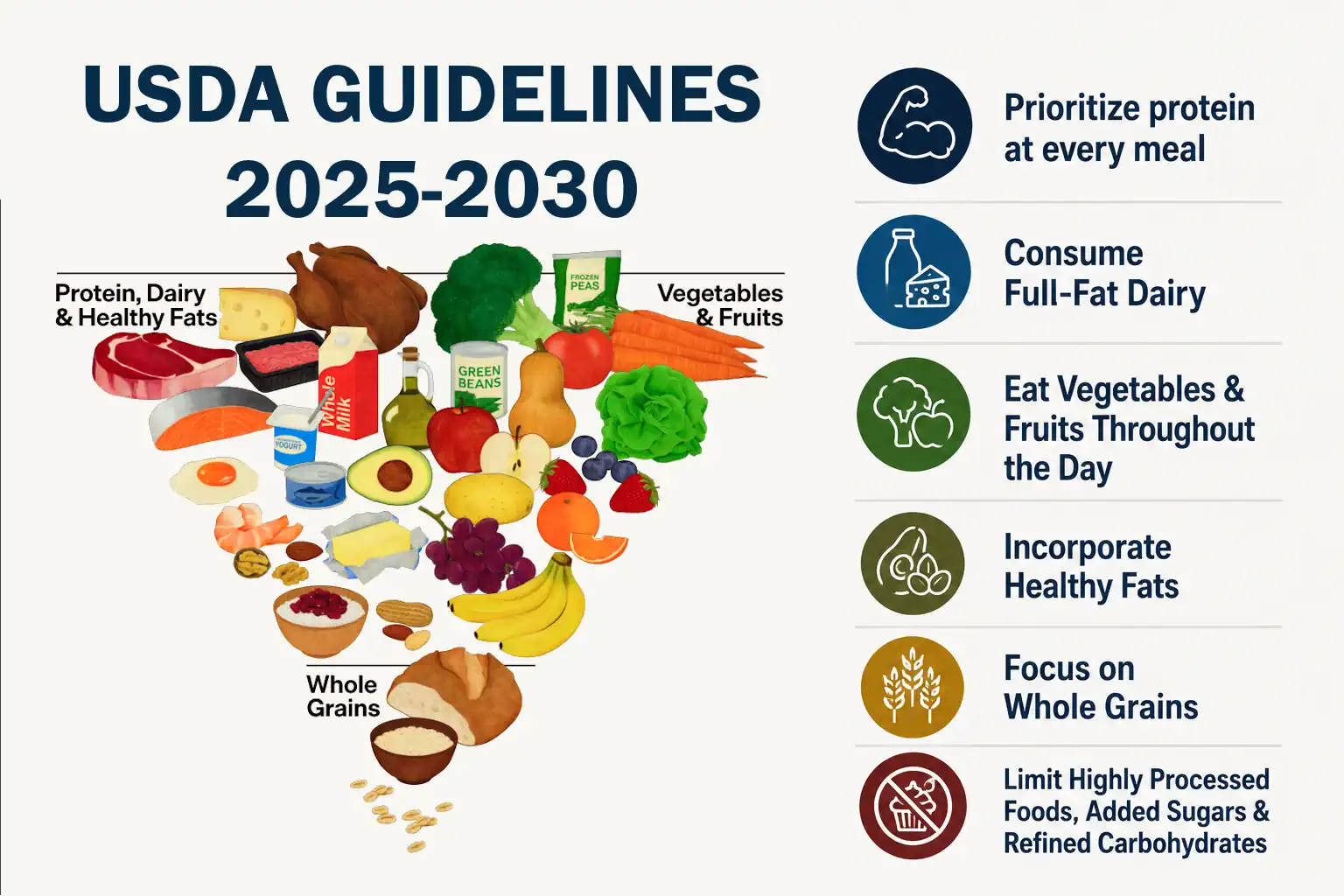
The USDA dietary guidelines 2026 (2025-2030) are designed to help Americans improve their health through better nutrition. They emphasize reducing sodium, limiting saturated fat, and maintaining a balanced diet.
On the surface, this approach seems reasonable. We know that diet plays a major role in long-term health. The American Heart Association has consistently linked poor diet to increased risk of cardiovascular disease and early death.
The guidelines also promote whole foods over processed foods and encourage a diet that includes fruits, vegetables, grains, dairy, and protein sources such as meat, poultry, and fish, while limiting highly processed foods, added sugars and refined carbohydrates.
Limiting intake of processed foods, added sugars and refined carbohydrates is unquestionably sound advice. At the surface level, in general the guidance to increase intake of “whole foods” (also called “Real Food” in the document) seems like a good idea. Taking a deeper look reveals some important caveats.
The guidelines focus on the foods we consume, but they largely ignore how some of those food products are produced. And this is very important as one reads the guidelines and makes choices about what food to buy and what to consume.
Many Believe the Guidelines Fall Short
Several respected institutions have already raised concerns about the USDA dietary guidelines 2026. The Harvard School of Public Health has pointed out what they describe as deviations from science.
They question the emphasis on animal protein over plant-based protein. They also highlight the guidelines recommendation to consume full-fat dairy while still recommending limits on saturated fat intake. And a very high protein intake is recommended.
These inconsistencies create confusion. It becomes difficult for the average person to follow the guidelines while also staying within recommended limits.
But even these concerns do not go far enough.
From my perspective in public health, the most significant issue is what the guidelines fail to address.
There is almost no discussion about the conditions in which much of this food is produced.
That omission is not minor. It changes the entire conversation.
What Factory Farming Really Looks Like Today
Most consumers never see where their food comes from. They see clean packaging and labels that suggest safety, high-quality products and well-cared for animals.
The reality is often very different.
In factory farming systems, animals are often viewed as units of production rather than living beings. Efficiency drives decisions. Cost reduction drives scale.
The result is a system where animal welfare is routinely secondary. Profit is prioritized over the well-being of the animals.
Every.
Single.
Day.
For billions of animals.
Factory farming, also known as industrial animal agriculture, is built for efficiency and scale. It produces large amounts of meat, dairy, and eggs at low cost.
But that efficiency comes at a price.
Let's start with fish.
Today, more than half of the fish consumed in the United States comes from fish farms.
These are not natural ecosystems. Fish are confined in dense enclosures where disease spreads easily, antibiotics and fungicides are administered routinely, and waste accumulates rapidly. Dead fish are not always removed right away, which further contaminates the environment.
In many cases, these fish are exposed to microplastics and other pollutants. Those contaminants do not disappear. They move through the food chain and ultimately reach the consumer after eating the fish.
If a fish is exposed to a poison or a chemical and you eat it - then you are exposed to that same chemical or poison as well.
Now consider poultry.
Chickens live in crowded barns with little to no space to move freely. They are unable to engage in natural behaviors like “dust bathing” or “perching.” Many never see sunlight. They live and die in the same overcrowded confined environment.
Chickens raised for food, often called broiler chickens, are bred to grow at an unnatural pace. Their bodies are engineered through selective breeding to produce large amounts of breast meat in a short time.
The result is an animal that grows faster than its body can support.
Many of these birds develop heart failure, as their hearts work overtime trying to pump blood to their genetically manipulated, Frankenstein - like bodies - and cannot keep up.
Others struggle to breathe as a result of the elevated poisonous ammonia levels they are forced to inhale from all the waste in their living space.
Their legs often cannot handle the weight of their bodies and routinely break, making them unable to walk. The birds, suffering in pain, unable to walk, may remain sitting in that environment until they die.
This is not an isolated, fictional description. It is a standard practice in industrial farming.
How about pigs? (raised and slaughtered to make your ham, bacon, and pork)
Pigs, in many operations, are kept in crates so small they cannot turn around. Throughout their pregnancy these special crates are called ‘gestation crates’. These intelligent, social animals are housed in tightly confined metal cages for extended periods during their lives.
And Cows? (raised and slaughtered to produce your steaks, hamburgers and dairy like cheese milk and ice cream)
Cows raised for beef or dairy spend time in feedlots where conditions are far removed from their natural grazing environments. No sun, no grass, no space.
Again, these are standard practices within large-scale industrial farming.
When people think about their food, they often imagine a traditional farm setting. Open land, animals roaming freely, maybe a red barn on a hill, and a connection to nature.
That image no longer reflects the reality for the overwhelming majority of the food supply.
One Moment That Made People Think Twice
Sometimes it takes an outside perspective to highlight what we have normalized.
Comedian Trevor Noah, when asked on The Daily Show what he would bring to America from Africa, told a story about the size of chicken wings here in America. He said chicken wings are not as big as they are here anywhere in the world.
His answer got laughs. But it reflects a real and important point.
The chickens in the US are not naturally that size. They are the result of decades of selective breeding designed to meet consumer demand for larger portions and lower prices.
What seems normal to us may actually be a signal that something has changed in a fundamental way.
Why This Matters More Than You Think
It is easy to separate nutrition from production. We look at protein content, fat levels, and calories.
But production affects more than nutrition - It affects health.
It raises ethical questions.
With the extremely fast pace that animals are moved along the slaughter line to be killed, (called “line speeds”) , animals are routinely not rendered unconscious before getting killed.
They are often conscious and alert, while having their throats slit and being dropped into a vat of scalding hot water (to make it easier to remove their skin).
This makes worker injury and illness more likely, and increases the likelihood of and diseased food entering the food supply.
Animals raised in crowded, stressful environments are more likely to become sick. Infections can easily pass from one animal to another. And when disease spreads through these populations, it creates opportunities for pathogens (like viruses) to evolve. And they can spread to humans.
This is where public health enters the conversation.
The Link Between Factory Farming and Pandemic Risk
In my podcast, Puppies, Pandemics, and Public Health, I explore the connection between animal agriculture and disease emergence.
One of the most important questions we can ask is this.
Where will the next pandemic come from?
Public health experts believe that factory farming creates ideal conditions for the development and spread of infectious diseases.
When thousands of animals are confined in close quarters, viruses and bacteria can spread rapidly. As they spread, they mutate.
Some of those mutations can allow diseases to jump from animals to humans.
This process is known as zoonotic transmission.
We have seen it before in various outbreaks. What is different today is the scale and intensity of industrial farming.
We are dealing with systems that house enormous numbers of animals in environments that amplify risk.
This is not speculation. It is a pattern that has been observed and studied.
It Is Not Just About Meat Production
While much of the discussion focuses on poultry, the same concerns apply to other areas of animal agriculture.
The current model of raising cows to produce dairy products uses many of the same unsanitary and low welfare conditions used in poultry production.
Cows are bred and managed for maximum milk production. This often involves intensive processes that can affect both the animals and the final product.
The adverse health effects of consuming dairy are well known. Some studies have linked dairy intake to conditions such as heart disease and certain cancers including prostate cancer and colon cancer.
How food is produced matters.
Why Nutrition Alone Is Not Enough
The USDA dietary guidelines 2026 focus on nutrients. They discuss protein, fat, sodium, and calories.
Those are important.
But they do not capture the full picture.
You can follow every recommendation and still consume food that comes from systems with significant ethical and public health concerns.
That is the gap I want people to understand.
Because once you understand that gap, the question changes.
It is no longer just about what is healthy on paper.
It becomes about what is healthy in reality.
Rethinking What "Healthy" Really Means
For many years, we have defined healthy eating in terms of nutrients alone. That definition is incomplete.
A truly informed approach to diet should include three factors.
First, the direct impact on your body.
Second, the conditions in which the food was produced.
Third, the broader impact on public health.
When you include all three, the conversation becomes more complex, but also more honest.
Some people will decide to reduce their intake of animal products. Others may choose to source food differently.
There is no single answer that fits everyone.
But there is a responsibility to understand the full picture.
So, Should You Change Your Diet?
The dietary guidelines suggest that animal protein can be part of a healthy diet.
From a nutritional standpoint, that can be true.
But nutrition is only one piece of the puzzle.
Once you understand how the majority of this food is produced, the decision becomes more personal.
You are not just choosing what to eat.
You are choosing what kind of system you want to support.
Final Thoughts on the New USDA Dietary Guidelines
The USDA dietary guidelines 2026 offer a framework for thinking about diet and health.
They provide useful information about nutrients, general eating patterns, and advice on what to consume.
However, they do not fully address the realities of modern food production.
My goal is not to tell you what to eat. My goal is to provide information that is missing from the conversation.
Factory farming is not just an ethical issue. It is a public health issue. It is also a transparency issue.
You have the right to understand where your food comes from, how it is produced, and what the serious consequences are of that production process. How food production, and what you eat, affects your health and the health of your family.
The USDA dietary guidelines for 2025 - 2030 recommend eating animal protein, including eating meat and dairy at every meal.
But now that you understand more about factory farming, disease risk, and the conditions behind the food on store shelves, I would encourage you to pause.
Ask yourself a simple question.
Do you really want to?
Always consult with your health care provider before making decisions about dietary changes, medications or supplements.
*This blog does not address the recommendation for 1.2-1.6 g per kilogram of protein daily. Best science does not support this very high amount of protein for optimal health and longevity.